
November 2, 2026
Reliable Energy, Inc. (REI) wishes to thank DEI for agreeing to an orderly process to issue a
Request for Proposals (RFP) in the fourth quarter of 2026 to gauge interest from third
parties in purchasing and operating the existing coal-fired units at the Cayuga Generating
Station (Cayuga). This should be the process that the IURC requires all utilities to use
before closing a generation plant, to ensure that ratepayers are receiving full value for
decades of investment and to mitigate the increasing rate impact of new generation.
Similarly, REI applauds DEI for its decision to extend the life of the Gibson generating plant.
This is a wise decision that recognizes that these units can continue to support Indiana’s
baseload generation needs well into the future. DEI’s dual strategy of expanding natural gas
while preserving existing coal heavily aligns with the regulatory, financial, and operational
model currently championed by the U.S. Department of Energy to secure grid reliability
amidst surging power demands.
REI has reviewed the Director’s Comments and finds that the 2024 DEI IRP has many of the
same flaws as previous IRPs. Six-hundred ninety-nine (699) days passed between DEI’s
submission of the IRP on November 1, 2024, and the issuance of the Director’s Draft
Report on October 1, 2026. The length of the IRP review process is so long as to render it
meaningless. Significant regulatory decisions were made in the interim, including the
Commission’s approval of $3.3 billion in natural gas generation at Cayuga (Cause No.
46193) and a $295.7 million base rate increase for DEI (Cause No. 46038).
Updating the Duke IRP earlier than the current due date of November 1, 2027, is merited
because:
1. There have been significant changes in utility outlook. Due to recent significant
changes in federal policy affecting the electric power industry, NIPSCO announced
that it will be accelerating its next IRP to complete it by December 31st of this year.
NIPSCO submitted its last IRP in December 2024. NIPSCO noted several changes in
the industry that impacted this decision, including tax credit changes, new
generation cost increases; and regional load growth. DEI and other utilities would be
wise to follow suit.
2. The most significant change has been the growth in data centers (DC), which are
barely mentioned in the 2024 IRP. As discussed below, the introduction of DCs2
affects power demand, the need for utility capacity, utility risks associated with
such capacity and how such capacity is regulated by host utilities.
3. Other issues that warrant additional updates include:
- a. Actual or expected changes in environmental regulations, and
- b. Actual or expected changes in fuel costs, and actual or expected changes in capital costs for new plants and infrastructure.
Specifically, the repeal of Section 111 greenhouse-gas requirements for power
plants is expected to take effect in November 2026. The repeal of Section 111(d)
eliminates the 90% carbon capture requirement and the 40% natural gas co-firing
requirement for medium-term units. Therefore, the repeal of Section 111(b) changes
the second-phase standards for gas turbines which are based upon 90% carbon
capture by 2032.
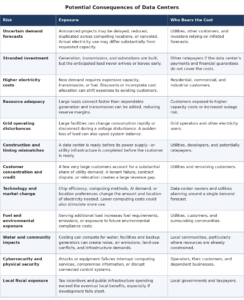
4. The expansion of DC’s could also have an increased costs for existing customers.
The cost categories are summarized below.
Conclusion
Respectfully, the IURC’s IRP review process should not take two years. Governor Braun’s
Executive Order 25-50 directed the Secretary of Energy and Natural Resources, in
coordination with the IURC and other stakeholders, to assess opportunities to pursue an
additive, rather than replacement-only, energy strategy while avoiding stranded asset costs
for ratepayers. The Indiana Office of Energy Development’s Executive Order 25-50 Annual
Report On Natural Gas and Coal Generation in Indiana (December 2025) recommended
that “Evaluating the cost benefit analysis between extending existing coal-fired generation,
purchasing power, and building dispatchable capacity should be done by utilities as part of
the IURC IRP process.” The IURC should follow through on this directive, and provide
meaningful and timely input on utility IRPs going forward.
